Why Google Reviews Are the Most Valuable Asset for a UK Tradesperson
Google reviews for tradespeople UK are one of the strongest ranking signals in local search, and they’re often the single deciding factor in whether a customer calls you or the competitor above you in the Local Pack. They don’t just build trust once someone’s already looking at your listing, they influence whether your listing shows up in the first place. If you’ve been treating reviews as a nice-to-have rather than a core part of your marketing, this is why that needs to change.
TL;DR
Google reviews affect two things at once: whether you rank in the Local Pack, and whether the people who see your listing actually call you. Google weighs review count, star rating, recency and how you respond as ranking signals, not just decoration on your profile. Most UK tradespeople have far fewer reviews than the businesses ranking above them, which is usually the single easiest gap to close. Contents
- What are Google reviews and why do they matter for tradespeople?
- How Google reviews affect your Local Pack ranking
- How many Google reviews for tradespeople UK actually need to rank
- Review velocity: why recent reviews count more than old ones
- Google reviews vs Checkatrade: which one actually helps your SEO
- What happens if you stop getting reviews
- FAQ
What Are Google Reviews and Why Do They Matter for Tradespeople?
Google reviews are ratings and written feedback customers leave directly on your Google Business Profile after they’ve used your services. Each review includes a star rating from one to five and, usually, a few lines of text about the job. For a tradesperson, they do two jobs at once.
They give Google a signal about how trustworthy and active your business is, which feeds directly into your Local Pack ranking. And they give the customer evidence, before they’ve ever spoken to you, that you turn up, do the job properly and don’t leave a mess behind.
Every other part of your Google Business Profile, your photos, your service list, your description, is something you write about yourself. Reviews are the one part written by someone else. That’s exactly why they carry so much weight, and why your reputation online compounds faster once reviews start coming in consistently.
How Google Reviews Affect Your Local Pack Ranking
Google has said publicly that reviews are one of the local search ranking factors behind how a business ranks, alongside relevance and distance. In practice, that comes down to a handful of specific signals:
- Review count. More reviews signal an established, active business. A profile with 60 reviews looks more credible to Google, and to customers, than one with 4.
- Star rating. A high average rating supports your ranking, but count matters more than a perfect score. A 4.6 rating with 80 reviews will usually outperform a 5.0 rating with 3.
- Review recency. Reviews that keep coming in show Google your business is still active and still doing work. A profile that hasn’t had a review in a year looks stagnant, even if the historic rating is good.
- Review responses. Replying to reviews, good and bad, signals that you’re actively managing your profile, not just leaving it to run itself.
- Keywords in reviews. When customers mention your trade or service in their review text, such as a great boiler installation or a blocked drain fixed fast, it reinforces the relevance signal Google already has from your profile. According to BrightLocal’s 2026 Local Consumer Review Survey, 97% of consumers now read reviews for local businesses before deciding who to contact. If your profile doesn’t have enough to read, customers move to the next listing that does. To see how changes in your review count translate into actual enquiries, read how to track calls and enquiries from your Google Business Profile.
How Many Google Reviews for Tradespeople UK Actually Need to Rank?
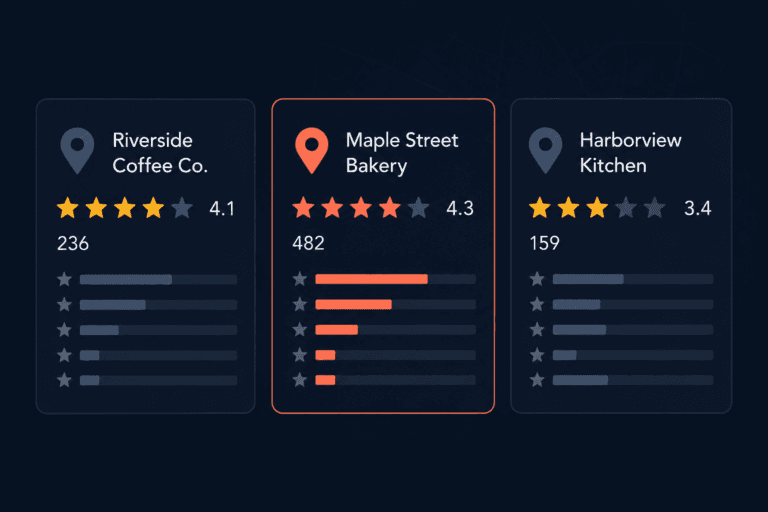
There’s no fixed number Google publishes, but the honest answer is: enough to be competitive with whoever’s already in the Local Pack for your trade and town. If the businesses in the top three have 60, 80 and 110 reviews, having 12 puts you at a clear disadvantage regardless of how good your work is.
As a rough guide, most UK tradespeople should be aiming for at least 20 to 30 reviews to be taken seriously in a competitive area, and 50 or more to start pulling ahead. But the number that matters most isn’t a fixed target, it’s the gap between you and the businesses ranking above you.
Check who’s currently in the Local Pack for your trade and area, and use their review count as your benchmark.
Review Velocity: Why Recent Reviews Count More Than Old Ones
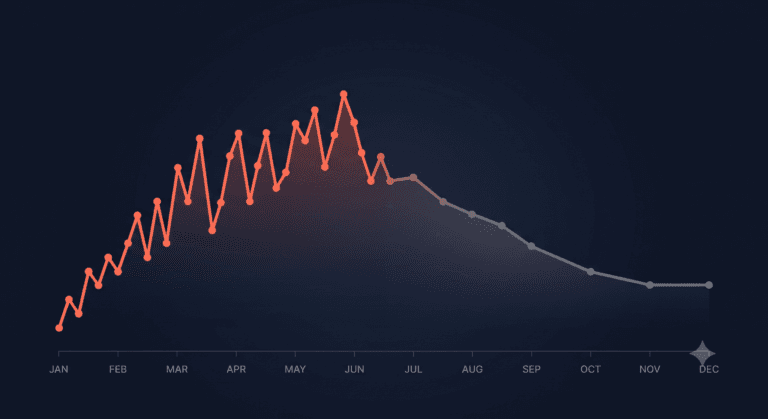
Review velocity is the rate at which new reviews come in. A business that picked up 40 reviews over five years and stopped is in a weaker position than one that’s picked up 15 in the last three months, even though the second business has fewer reviews overall.
Google reads a steady flow of recent reviews as a sign of an active, currently trading business. A pile of old reviews with nothing new tells Google the opposite, even if nothing about the business has actually changed.
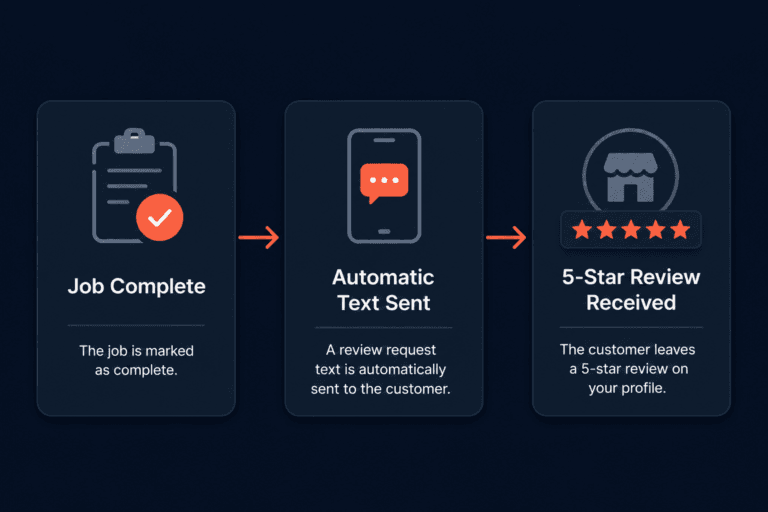
This is why a system for asking every customer for a review after every job matters more than a one-off push to get your numbers up. Consistency, not a single burst of activity, is what Google is actually measuring.
Google Reviews vs Checkatrade: Which One Actually Helps Your SEO?
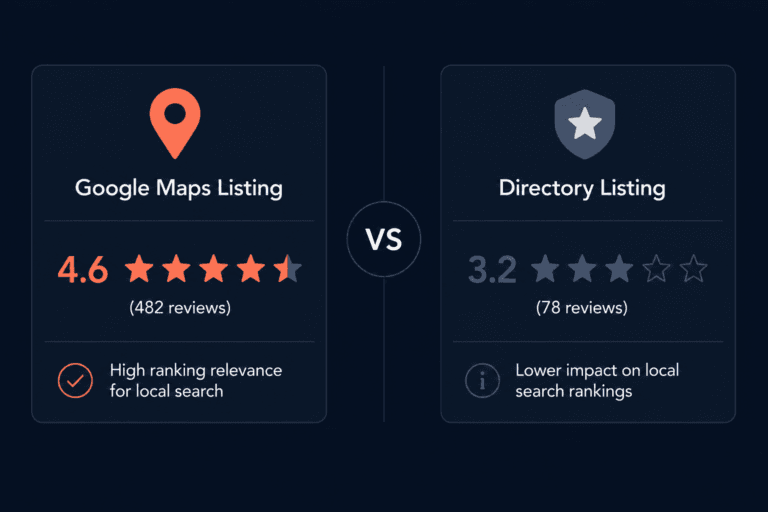
Checkatrade and similar trade directories are useful for trust and lead generation, but they don’t carry the same weight for your Google ranking. Here’s how they compare:
| Google Reviews | Checkatrade Reviews | |
|---|---|---|
| Affects Google Local Pack ranking | Yes, directly | No, not directly |
| Visible to customers searching on Google | Yes, immediately | Only if they click through |
| Free to collect | Yes | Requires paid membership |
| Builds customer trust signals before first contact | Yes | Yes |
| Counts toward review velocity | Yes | No |
| Checkatrade reviews still matter for trust and for customers who specifically search Checkatrade before booking a trade. But if your goal is ranking higher when someone searches your trade and town on Google, Google reviews are the ones doing the actual work. |
What Happens If You Stop Getting Reviews?
Nothing happens overnight, and that’s exactly why it’s easy to miss. Your existing reviews don’t disappear and your star rating doesn’t collapse. But your review velocity flattens, and slowly, the businesses still collecting reviews every week start to pull ahead of you in the Local Pack.
This is the same pattern that shows up across local search: a business doesn’t lose its ranking because something went wrong, it loses ranking because something stopped happening. Reviews are one of the clearest examples. The tradesperson who’s still asking every customer for a review in month twelve is building an advantage the tradesperson who stopped in month three can’t easily close.
FAQ
Do Google reviews help with local SEO ranking?
Yes. Google has confirmed that reviews, specifically review count, rating and recency, are one of the main local search ranking factors, alongside relevance and distance from the person searching.
How many Google reviews does a tradesperson need?
There’s no official minimum, but most tradespeople need at least 20 to 30 reviews to be competitive, and 50 or more to rank strongly in a busy area. The real benchmark is the review count of the businesses currently ranking above you.
Are Google reviews more important than Checkatrade reviews for SEO?
Yes, for your Google ranking specifically. Google reviews feed directly into your Local Pack position. Checkatrade reviews build trust and can generate leads, but they don’t influence how you rank on Google.
Does responding to Google reviews affect ranking?
It’s one of the signals Google considers as part of an actively managed profile. Responding to every review, positive and negative, also shows potential customers you take feedback seriously.
What if I get a negative Google review?
Respond calmly and professionally, address the specific issue, and avoid getting defensive in public. A single negative review among a healthy number of positive ones rarely does lasting damage, but ignoring it or reacting badly can.
Can I ask customers to leave a Google review?
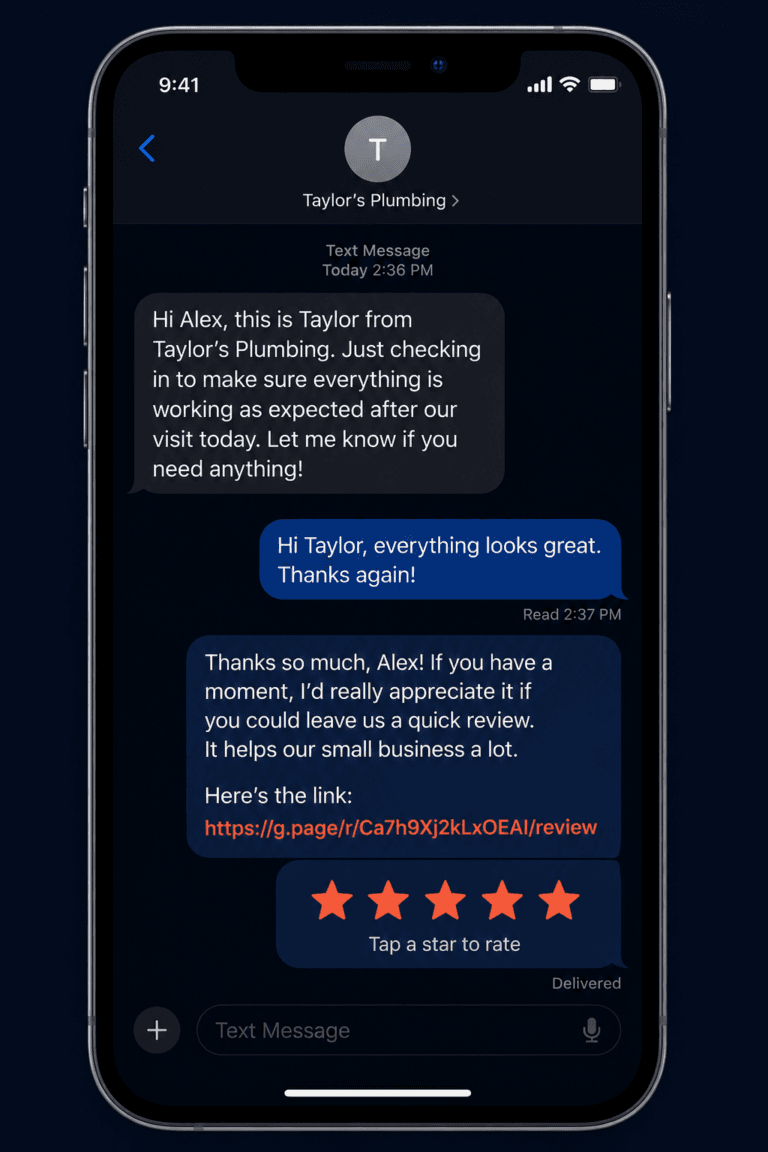
Yes, and you should. Under Google’s review policy, you can ask customers directly, you just can’t offer incentives in exchange for reviews or ask only for positive ones. A direct link to your review page, sent straight after a job, gets the best response.
The Bottom Line
Google reviews for tradespeople UK aren’t a vanity metric, they’re one of the clearest levers you have over your local ranking and the calls that come from it. Count, rating, recency and how you respond all feed into a system that rewards the businesses that keep asking, month after month. If you want to know exactly where your review count and rating stand against the competitors ranking above you right now, I offer a free Local Visibility Report that shows you the gap and what it’s costing you.
Ready to see how visible your business actually is? Get your free Local Visibility Report at neonlobster.ai/local-visibility-report/ and I’ll show you where you stand and what it would take to improve it.
From Gigi, The Neon Lobster
Want to know exactly where you stand in local search?
We’ll scan your Google Business Profile, your reviews, and your map pack visibility. Then we’ll send you a personalised Local Visibility Report showing what’s working, what’s missing, and what it’s quietly costing you each month. It’s free, it takes two minutes to fill in, and you’ll have your report the same day.
Get My Free Local Visibility Report →No sales call. No obligation. Just honest numbers about where you stand online.